Cross-National Public Opinion About Homosexuality: Examining Attitudes Across the Globe
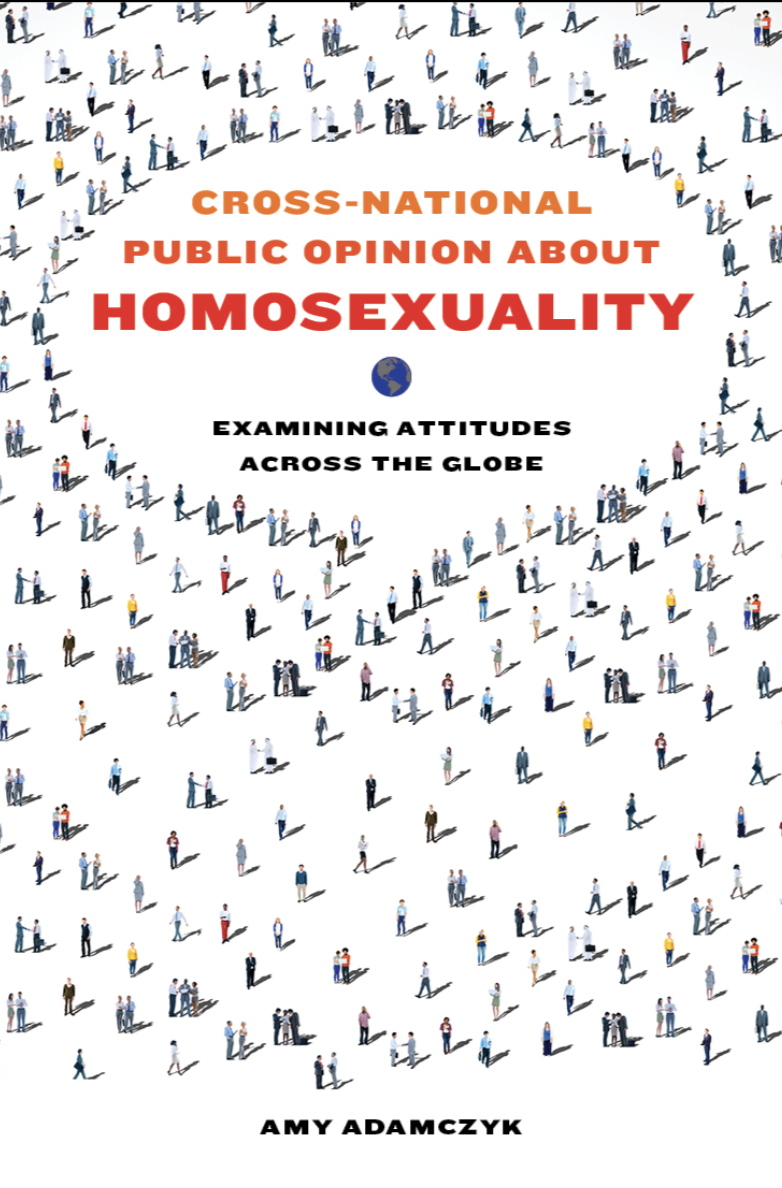
Public opinion about homosexuality varies substantially around the world. While residents in some nations have embraced gay rights as human rights, people in many other countries find homosexuality unacceptable. What creates such big differences in attitudes? This book shows that cross-national differences in opinion can be explained by the strength of democratic institutions, the level of economic development, and the religious context of the places where people live. Amy Adamczyk uses survey data from almost ninety societies, case studies of various countries, content analysis of newspaper articles, and in-depth interviews to examine how individual and country-level characteristics influence acceptance of homosexuality.

“A perfect issue-based case study of how prejudicial attitudes toward minorities groups can be decreased at a country level. Highly recommended as a thought-provoking introduction for both undergraduate and graduate students of social movements, social change, prejudice, comparative public opinion, or any of the many other fields of study the book spans.”
“[A] significant contribution to our overall understanding of public opinion about homosexuality.”
“A must-read for both academics and non-academics, including policymakers, governmental officials, and non-profit practitioners who are committed to policy formation, law enforcement, and advocacy for LGBTQ persons worldwide.”
“What accounts for the range of differences in acceptance of gay, lesbian, bisexual, transgender, and queer persons throughout the world? Amy Adamczyk has woven an impressive tapestry of nuanced answers to this urgent and complex question.”
“An excellent comparative analysis of the degree of anti-gay attitudes in many nations... Summing Up: Highly recommended.”
“In this groundbreaking book Adamczyk has undertaken the daunting task of unraveling the complex dynamics shaping public opinion about same-sex relationships. She provides a rich theoretical understanding of the macro forces influencing attitudes and impressively integrates multiple types of methods and data to assess these ideas. A major contribution to cross-national public opinion research that I highly recommend.”

“Adamczyk has written the most comprehensive contemporary study on disapproval of homosexuality. She takes into account multidisciplinary theoretical insights on individual as well as contextual determinants to provide a worldwide readership with enlightening overviews on controversial issues.”
“Conversation around the topic of diversity has never been more timely on college campuses, and Professor Adamczyk takes up the important subject of sexual diversity, offering a wide-ranging portrait of attitudes about same-sex relationships on a global scale. For graduate and undergraduate students interested in gay rights and sexual identity, Adamczyk’s new book offers an essential window into how religion, politics, and economic development affect public opinion on these topics, and will surely spark passionate campus conversation about her findings.”
“Few studies have explored change in attitudes toward homosexuality on a global scale. Adamczyk’s mixed-methods approach and breadth of case studies, as well as her original and stimulating treatment of her materials, make for an ambitious and timely work that offers an important contribution to the scholarly community.”
“Drawing from a wealth of quantitative and qualitative cross-national data, Adamczyk provides an illuminating analysis of cross-national patterns in attitudes toward homosexuality. This highly informative book is essential reading for anyone seeking to understand the societal roots of sexual prejudice and tolerance in the 21st century. I strongly recommend it.”
“True cross-national studies of public opinion are rare, and even rarer still are those that take religious differences seriously. Adamczyk explores the diversity and sources of opinions among Protestant, Catholic, Muslim, and Confucian/Buddhist majority countries. I recommend this book highly to those interested in the intersection of religion and the politics of sexuality, and of those interested in comparative public opinion more broadly.”
Publicity and Press
-
Cross-National Public Opinion about Homosexuality
Public opinion about homosexuality varies substantially around the world. While residents in some nations have embraced gay rights as human rights, people in many other countries find homosexuality unacceptable. What creates such big differences in attitudes? This book shows that cross-national differences in opinion can be explained by the strength of democratic institutions, the level of economic development, and the religious context of the places where people live.
-

Why do some countries disapprove of homosexuality? Money, democracy and religion
With Trump’s removal of federal protections for transgender students, debate over LGBTQ rights rage again across the U.S.
Despite these disagreements, Americans are relatively liberal compared to countries across the world, where the consequences for gay or transgender citizens are far more dire.
-

Why are some places gay-friendly and not others?
When Taiwan became the first place in Asia to legalise same-sex unions, hundreds of gay people marked the occasion by registering to marry.
It marked a significant change on the island, where the majority of people only relatively recently became supportive of same-sex relationships.
In many other places there has also been a shift - often a rapid one - towards more liberal attitudes.
-
LGBT People and the Continuing Quest for Dignity
Dr. Amy Adamczyk, a professor at John Jay College of Criminal Justice and the Graduate Center, CUNY, participated in a panel discussion titled "LGBT People and the Continuing Quest for Dignity" in celebration of the 64th Anniversary of the Universal Declaration of Human Rights. The event, moderated by Prof. George Andreopoulos, focused on the ongoing struggle for dignity and rights for LGBT individuals.
-

Trump and Homosexuality: Differences in Public Opinion
Like many academics, I was surprised at how well Donald Trump did early in the presidential election, securing the Republican nomination and at times rivaling Hillary Clinton in the polls. Part of the reason I was so surprised is because almost everyone I know and spend time with is a staunch democrat, socialist, or even communist. For many academics most of our friends are very liberal left-leaning highly educated people. For me it is even more extreme because I am childless and live in Manhattan. So the thought of millions of Trump enthusiasts has been hard to fathom.
-

Religious Transmissions from Parents to Children
A variety of factors can shape how religious parents approach passing on religion to their children. Learn more from Dr. Amy Adamczyk (City University of NY, CUNY) in the next Family Summit video recap.
-

Queer Rights Deep Dive
Amy Adamczyk, sociologist and author of the 2017 book, Cross-National Public Opinion about Homosexuality, leads us through a deep dive of why some countries protect their LGBTQ+ citizens and others villainize them.
-

Public Opinions on Homosexuality
Public opinion about homosexuality varies substantially across the world. While in some countries, like Saudi Arabia, individuals can be killed for having a same-sex relationship, in other places like, the Netherlands, gay rights have been embraced as human rights. Why are there such big differences in how people across the world view this issue? This is the issue that I sought to examine.
-

Faith, Sex, And Culture: Why LGBT Attitudes Vary Widely Across Nations
Dr. Amy Adamczyk, a sociologist at the City University of New York, was featured for her groundbreaking work in the book Cross-National Public Opinion About Homosexuality: Examining Attitudes Across the Globe. Drawing on data from the World Values Survey covering nearly 85 percent of the global population, as well as case studies, media analysis, and interviews, Dr. Adamczyk explores how religion, economic development, and democratic values shape global attitudes toward homosexuality.
-

Cross-National Public Opinion about Homosexuality: Examining Attitudes across the Globe
Attitudes toward homosexuality vary widely across the world. While some societies view gay rights as basic human rights, others strongly disapprove of homosexuality. These differences are largely influenced by the strength of democratic institutions, levels of economic development, and the dominant religious culture in each country.
-
Cross-National Public Opinion about Homosexuality: Examining Attitudes across the Globe
Public opinion about homosexuality varies substantially around the world. While residents in some nations have embraced gay rights as human rights, people in many other countries find homosexuality unacceptable. What creates such big differences in attitudes? This book shows that cross-national differences in opinion can be explained by the strength of democratic institutions, the level of economic development, and the religious context of the places where people live.
-
Cross-National Public Opinion about Homosexuality: Examining Attitudes across the Globe
Over the last 25 years, global attitudes involving homosexuality have shifted more tolerant on nearly every continent. This transformation represents what is almost certainly the largest and most well observed shift in global preferences on any issue in public opinion. This change has been uneven across the globe, with shifts being the most intense in the developed nations of Western Europe, North American, Southern Latin American, and parts of the Pacific Rim. Little change has occurred in most of Africa and in Muslim nations. In Cross-National Public Opinion about Homosexuality: Examining Attitudes across the Globe, Amy Adamczyk presents an important survey of this development.
-
The socioeconomic aspect of homosexuality across the world
Reviews the book, Cross-National Public Opinion About Homosexuality: Examining Attitudes Across the Globe by Amy Adamczyk (see record 2017-05222-000). When discussing a topic such as homosexuality across the world, the psychological discourse often takes priority, followed by cultural and religious issues. While much research has been done about the topic and evidence-based data collected from a psychological perspective, the sociocultural component still relies more often on opinions and observations of society and less on hard-core data.
-
From Tolerance to Equality: How Elites Brought America to Same-Sex Marriage
This book review discusses the shift in American public opinion on same-sex marriage, noting that support grew from 35 percent in the early 2000s to 55 percent by 2015, when it became legal nationwide. Instead of crediting social movements, activists, or cultural liberalization, the author emphasizes the role of elites in driving this change. Drawing on Pierre Bourdieu’s theories of class, power, and symbolism, the book argues that elites—broadly defined—were instrumental in influencing both legislation and societal attitudes, highlighting that class extends beyond economics to include cultural and symbolic capital.
-

What Makes a Culture Tolerant?
SAME-SEX MARRIAGE is now legal in two dozen countries—while same-sex sexual behavior remains punishable by death in seven others. What accounts for the range of differences in acceptance of gay, lesbian, bisexual, transgender, and queer persons throughout the world?